Lobster Stew with cheddar crostini

Two weekends ago,  my family and I all holed away together in New Brunswick for Canadian Thanksgiving.  We wanted to celebrate and mark this special occasion with a traditional feast, but I did not want to commit to staying home all day nursing a turkey and all its accompaniments and miss out on a beautiful hike.  Plus, we will have our turkey next month in the U.S. – not to mention that, lets face it,  by the time October rolls around I am a bit “turkey-ed out,” as I have been cooking (aka styling) thanksgiving spreads for different clients since July.

Lobster seemed to be the perfect solution, and quite fitting since we are on an island where the economy is based on  fishing and lobstering.  My only problem:  how to prepare it.  I wanted it to feel special yet uncomplicated.  I didn’t want to serve it grilled or steamed – something closer to “comfort food” seemed more fitting for October.  Lobster mac & cheese? Lobster pot pie seemed appealing, but I was worried of overcooking the lobster.  Then I thought: how about deconstructing the pot pie? More of a lobster stew with crostini?

Lobster Stew with Crostini

  • Meat from 4 medium lobsters steamed and cut into 1 inch chunks
  • 1 onion diced
  • 2 celery stalks diced
  • 2 medium carrots diced
  • 2 medium parsnips diced
  • 1 large yukon gold potato diced
  • 1 tablespoon olive oil
  • 3 tablespoon butter
  • 1/3 cup flour
  • 3 cups chicken broth
  • 2 tablespoon fresh chopped parsley
  • 2 cups milk
  • salt and pepper

In a large stock pot melt 1 tablespoon butter with the oil.  Add the onion and cook until soft and translucent, about 3 minutes .  Add the diced vegetables and sautée on medium/high heat covered for 15 minutes, stirring once in a while and checking that the vegetables don’t brown.

Add 2 tablespoon butter. Once melted, add the flour and mix well until fully incorporated.  Cook for 2 minutes.  Add the chicken broth and parsley.  Bring to a boil, reduce the heat and simmer for 10 minutes.  Add the milk and return to a simmer.  Add the lobster meat, give the stew a stir and turn off the heat.  All you want to do here is heat the lobster.

Serve in large shallow bowls with the crostini.

Cheddar Crostini

  • one baguette
  • about 1/2 pound mild cheddar

Preheat oven at 400 degrees.

Cut the baguette into 1/2 inch slices on the diagonal to get long slices. Grate or slice the cheddar. On a sheet pan, cover the baguette slices with the cheese and bake in the oven for 8 minutes or until the cheese is melted, bubbly and golden.

NOTE: When getting lobster on the island we steam it in a bit of fresh sea water – if not you can get most fish markets to steam it for you.  As for the crostini, I count 2 per person when serving the stew but make sure there are extras on the table, since we found them quite addictive!

From my kitchen to yours,

CK, la fille du boucher

Roasted Carrots and/or Parsnips

Want a simple side dish? Something so easy it practically cooks itself, bringing out all of the natural flavors? Try roasting vegetables.  In this case I opted for carrots and parsnips.  This time of year they are in season and you can find many varieties of carrots at the farmer’s market.  All you need is fresh carrots, best quality olive oil, coarse sea salt, and herbs, and you have a great side dish.

Roasted Carrots or/and Parsnips

  • 2 bunches carrots or parsnips or a mix of the two
  • 1/4 cup extra virgin olive oil
  • 1 tablespoon coarse sea salt
  • 3 tablespoon fresh thyme chopped

Preheat oven at 400 degrees.

Cut off tops and bottoms of carrots and parsnips.  Peel and cut into fat matchsticks about 2 inches long.  To do so, cut the vegetable in half or third depending on the length.  Keep the bottom part intact and quarter or halve the top part depending on its thickness. You want the matchsticks to be close in size so they all roast evenly.

In a bowl, toss the vegetables with the oil, salt and herbs.  Transfer to a baking sheet and roast in the oven 15 to 20 minutes or until tender and golden, turning the vegetables once or twice during cooking time for even browning.  

NOTE: In the spring when baby carrots are available, roast them whole. Try different herbs or flavored oils; experiment and have fun!

From my kitchen to yours,

CK, la fille du boucher

Clam Chowder and Clamming

We had the opportunity to spend last weekend “en famille”.  Those occasions are rare now with everybody’s busy schedules.  I treasure those days where time stands still. There are no outside distractions from phone calls, emails and such.  Our only concern  is where will be our next outing or hike.  We cook a lot, experiment with ingredients a lot, and, needless to say, eat a lot.  Leisurely meals, great conversations, and laughs are what those days are all about.

This weekend marked our last visit to the clam flats and we ended up coming home with more clams than we anticipated.  Clamming is so much fun until you get to the cleaning… which is not so much fun, but in the end very rewarding.  Clam chowder brings to mind summers in New England;  but there is something comforting about eating a big bowl of clam chowder with the fire roaring in the wood stove on a brisk October day. I serve it with a big dose of cracked pepper, a nice crusty bread, and … lots of butter.

Clam Chowder for a crowd    (this recipe serves about 10 to 12)

  • 3 thick slices of bacon diced
  • 1 large onion diced
  • 2 large yukon gold potatoes diced
  • 4 cups chicken broth (you can also use vegetable broth)
  • 3 cups chopped clams
  • 3 cups half and half cream
  • 1 cup bechamel sauce (optional)

In a large pot sautée the bacon in a teaspoon of oil until soft.  Add onion and sautée until translucent, about 5 minutes.  Add the potatoes and stir to cover with oil and juices   rendered from the onion.  Add the broth and bring to a boil, reduce heat and simmer until the potatoes are starting to get soft.  Add the clams and simmer for 2 minutes.  Add the half and half and let the chowder get hot without boiling.  The chowder can be made ahead of time, cooled down, refrigerated and slowly heated up later or the next day.

NOTE: our family likes a thick chowder.  That’s were the optional 1 cup bechamel comes in.  Melt 3 tablespoon butter in a sauce pan add 1/4 cup flour let it cook slowly for 2 minutes.  Add 1 cup warm milk and whisk until it starts to thicken.  Add to the chowder after the half and half.  

From my kitchen to yours

CK, la fille du boucher

Classic Tuscan Flatbread

While on vacation this summer I was looking for a simple bread recipe.  I did not want to commit myself to running back to the house every two hours to punch the dough.  With no internet connection and a handful of cookbooks what was I to do? I went through my stack of old magazines and found the perfect recipe in Bon Appetit Magazine, the special collector edition From May 2000: Tuscany.  If you are looking for a bread to eat alongside a  soup, salad or stew, this is your bread.   It is great too for an antipasto platter and for dipping in oil and spreads.  As the bread came out of the oven we started tearing it into chunks and between warm mouthfuls everybody was putting in their two cents about the recipe.  My daughter suggested that a sprinkle of fresh rosemary would make it perfect and that’s what I did on the second round… thanks Maya!  Going back to the article and reading notes about the origin of the bread: Schiacciata (skah-shah-‘tah) I discovered that it is very versatile when it comes to its toppings: tomatoes, olives, sauteed onions.  It can be turned into a breakfast bread by adding raisins.  

Classic Tuscan Flatbread (for 1 round loaf)

  • 1 cup lukewarm water (90 to 100 degrees F)
  • 2 packages dry yeast (1/4 oz each)
  • 2 1/2 cups all purpose flour
  • 4 tablespoons extra virgin olive oil
  • 1 tablespoon coarse sea salt
  • 1/4 cup fresh chopped rosemary

Pour 1 cup lukewarm water into small bowl, sprinkle with yeast.  Let stand until yeast dissolves, about 10 minutes.

Place 2 cups flour in large bowl.  Make a well in center of flour.  Pour yeast mixture into well.  Using a fork, stir until dough comes together.  Knead in bowl, adding enough flour 1/4 cup at a time to form slightly sticky dough.  Transfer to floured work surface.  Knead until dough is smooth and elastic, about 10 minutes. Coat bowl with 1 tablespoon oil.  Add dough and turn to coat. Cover bowl with plastic wrap.  Let stand in warm draft-free area until doubled, about 1 hour 15 minutes.

Brush an 11 inch tart pan with removable bottom with 1 tablespoon oil.  Punch down dough.  Turn out onto floured work surface and shape into an 11 inch round.  Transfer dough to prepared tart pan or a baking sheet if you don’t have a tart pan.  Cover loosely with plastic.  Let rise until dough is almost doubled in size, about 30 minutes.

Preheat oven to 400 degrees.  Press finger tips into dough, creating indentations.  Brush with remaining 2 tablespoons oil.  Sprinkle with salt and rosemary.  Bake until golden, about 28 minutes.  Cool bread in pan on rack 10 minutes.  Remove bread from pan and cool completely.

NOTE:  there are so little ingredients to this recipe so make sure you use the best quality olive oil and salt.  I use sel gris (gray salt).

From my kitchen to yours,

CK, la fille du boucher


Pears wrapped in prosciutto

This is more of an idea then a recipe and it’s EASY!!! Really.  All my friends roll their eyes when I say : “it’s easy” but it is really true for this one.  This time of year I like to use seckel or forelle pears.  If you can’t find them you can use medium size bosc pears.  As a first course I count one pear per person and for the bosc 1/2 pear.  I also make more then I need for the guest who wants an extra serving and for leftover the next day.  They make a  great lunch sliced cold on top of a salad.  This is what you will need for 4 people.

PEARS WRAPPED IN PROSCIUTTO

  • 6 seckel pears
  • 3/4 pound blue cheese (pick your favorite as each type varies in intensity and taste)
  • 6 slices prosciutto
  • pomegranate molasses

Wash the pears, cut in half and with a spoon dig out the seeds, creating a well .  Cut a good size nugget of the blue cheese and place in the well.  Cut the prosciutto slices in half the long way.  Wrap each pear with the prosciutto.  Place on a lightly greased cookie sheet.  Bake in the middle of  a preheated 400 degrees oven for about 20 minutes or until the cheese melts, the prosciutto gets a bit crispy and the pears soften a bit.  Let cool to room temperature and serve on a bed of arugula  individually or on a platter with a drizzle of pomegranate molasses on each pears.

NOTE: you can now find pomegranate molasses in most grocery stores. If not, you can make a balsamic vinegar glaze by reducing 1 cup of the vinegar on top of the stove at a slow boil until it thickens.  Watch carefully as it can turn rapidly from nice glaze to burnt caramel!

From my kitchen to yours!

CK, la fille du boucher

Peach Galette

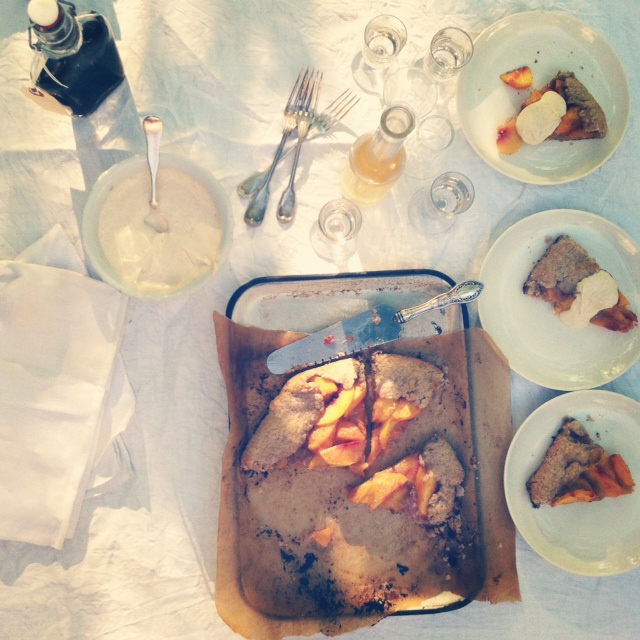
“You’ll never go back to making pie once you’ve made a galette” that’s what I like to say each time I serve a galette. Well, maybe not but I just want to emphasize how easy and rewarding this dessert is.  I LOVE it’s rustic look and the fruit ratio to the dough.  Eat it as is, with ice cream or whipped cream OR with a mascarpone lemon sauce. The dough and the sauce can be made a day or two before. This recipe serves 6 to 8 people, especially if you serve it with the sauce.

PEACH GALETTE

DOUGH

  • 1cup flour
  • 2 tbs sugar
  • 1/2 tsp cardamon
  • 1/2 tsp cinnamon
  • 1/4 tsp salt
  • 1 stick cold unsalted butter (1/4 lb) cut in small pieces
  • 3 tbs very cold water

Put the dried ingredients in the bowl of a food processor and pulse a few times to blend. Scatter the pieces of butter on top of the mix and pulse until the mixtures resemble coarse cornmeal.  With the motor running pour the water and let the mixture get wet.  It won’t look like “wet” dough but if you rub it between your fingers, it should stick together. If not add another tablespoon.  Invert the mixture onto a clean surface and form into a ball, flatten it into a disk, wrap in plastic wrap and let rest in the fridge for at least 1 hour or up to 2 days.

FILLING

  • 4 peaches (about 1.5 pound)
  • 1/4 cup sugar
  • pinch of salt
  • 1/4 cup flour
  • 1/2 tsp cinnamon
  • 1/2 tsp cardamon
  • zest and juice of 1/2 lemon
  • 2 tbs cold unsalted butter cut into small pieces

Peel peaches by dunking them in a pot of boiling water for about 2 minutes or until the skin   comes out easily.  Halve, core and cut the peaches into 1/4 inch slices.  In a large bowl mix the dried ingredients. Gently toss the sliced peaches into the mixture to cover them.  Toss the zest and lemon juice.  Put aside as you are rolling the dough.

ASSEMBLING THE GALETTE

On a piece of parchment paper roll out the dough into a 11 inch round.  Transfer the peach mixture onto the dough leaving a 2 inch border all around. Scatter the 2tbs butter on top of the peaches.  Carefully fold the border into the galette forming the galette as you are folding.  The galette does not need to be perfectly round, that’s the beauty of the galette!  Transfer the whole piece of parchment / galette to a baking sheet and return to the fridge for 20 minutes.  In the meantime preheat the oven at 400 degrees .  Bake 20 to 30 minutes or until the crust is nice and golden and the filling is bubbling.  Serve warm or at room temperature.

MASCARPONE LEMON SAUCE

  • 1 cup mascarpone
  • 2 tbs whipped cream cheese
  • 2 tbs sour cream
  • 1/4 cup dark brown sugar
  • 1/4 tsp cinnamon
  • zest of one lemon
  • 1 tbs lemon juice
  • 1 tbs limoncello (optional)

In a bowl mix all the ingredients and whisk until smooth.

NOTE:  it is very important to make sure the galette goes in the fridge and is cold before baking, that is how you will get a nice flaky crust.

From my kitchen to yours!

CK, la fille du boucher

Zucchini pickle

For my first post, I give you “my” zucchini pickle recipe.  “My” because I got it from a book we bought at L.L.Bean (of all places) about 30 years ago.

Putting Food by:  The No.1 book about all the safe ways to preserve food,  by Ruth Hertzberg, Beatrice Vaughan and Janet Greene

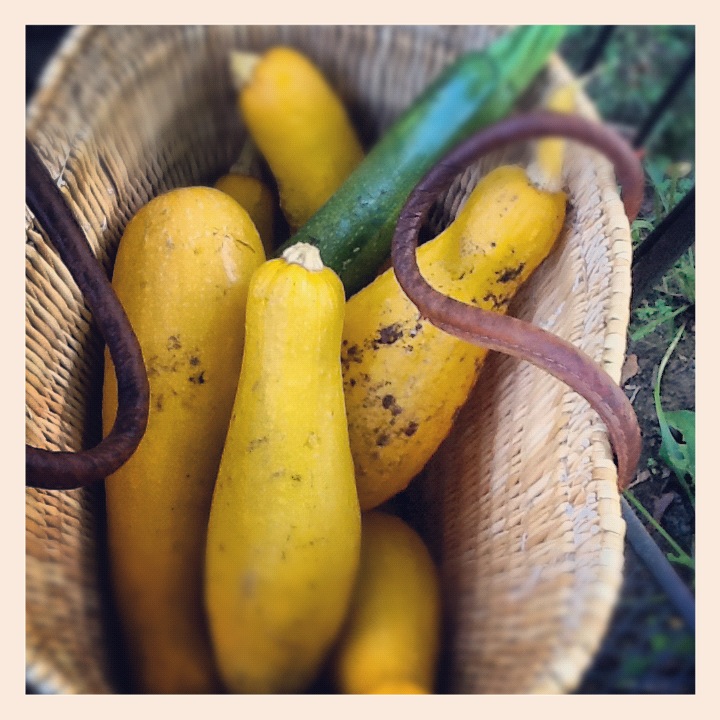
It’s my go to book whenever I want to pickle.  The recipe calls for thin slices of small zucchini; well, I use those sneaky zucchini that hide and once you find them are the size of baseball bats! I make sure to core them, take the seeds and fibers out and cut them in one inch pieces.  For a pretty colorful mix I sometime add some yellow squash that also have escaped early picking.  So to all my friends who have been asking about the recipe lately, here it is

ZUCCHINI PICKLE

  • 2 quarts thin slice of unpeeled, small zucchini squash
  • 2 medium onions, peeled and thinly sliced
  • 1/4 cup salt
  • 2 cups vinegar
  • 2 cups sugar
  • 1 teaspoon celery seed
  • 2 teaspoon mustard seed
  • 1 teaspoon turmeric
  • 1/2 teaspoon dry mustard

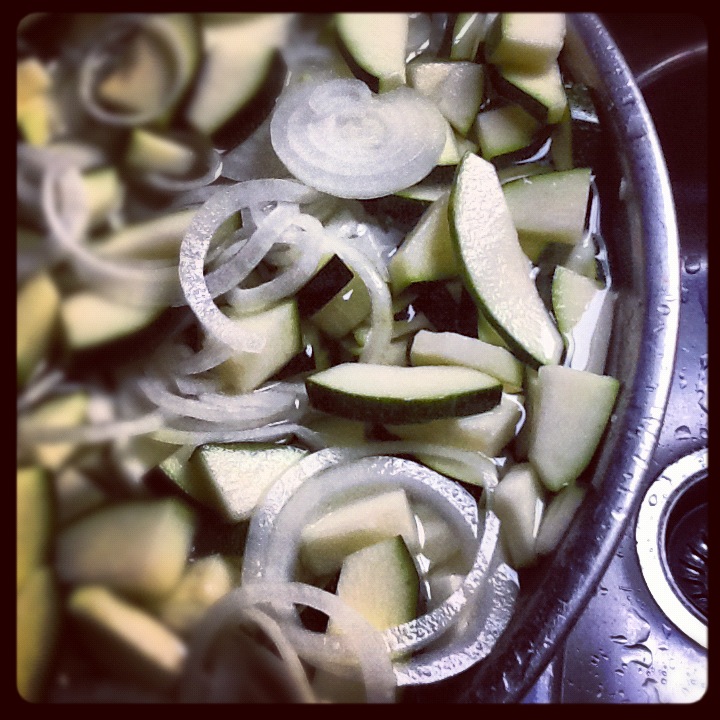
Combine zucchini and onions.  Sprinkle with the salt, cover with cold water and let stand 2 hours.  Drain; rinse with fresh water, and drain again.  Combine remaining ingredients in an enamelware kettle and bring to boiling.  Cook 2 minutes.  Add zucchini and onions, remove from heat, and let stand 2 hours.  Bring again to boiling and cook 5 minutes.  Ladle hot into hot pint jars, leaving 1/2 inch of headroom and process in a Boiling-Water Bath (212F) for 10 minutes.  Makes about 4 pints.

Note: it is always important when canning that the jars, lids, pots be clean and sterilized. You can do so by boiling the jars 15 minutes or if you have a very hot drying cycle in your dishwasher. If you make a small amount of pickles and don’t want to bother with processing, put the jars in the fridge once they have cool to room temperature.

from my kitchen to yours!

CK, la fille du boucher